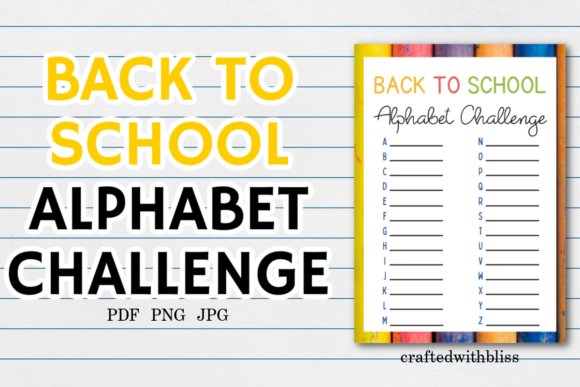
Back to School Alphabet Challenge Game
As the back-to-school season gears up, parents, teachers, and homeschoolers are constantly searching for creative, low-stress ways to ease children back into learning routines. The Back to School Alphabet Challenge Game offers a simple yet powerful tool: a themed A-to-Z list that asks kids to name a school-related item for each letter. But as with any seemingly straightforward resource, small missteps can turn a promising activity into a frustrating experience. Let’s explore how to use this challenge effectively, avoid common pitfalls, and get the most out of that PDF, PNG, or JPG file designed for A4 paper.
What Is the Back to School Alphabet Challenge Game?
At its core, the alphabet challenge is a brainstorming activity. You present a letter—whether it’s “A” for apples, “B” for backpacks, or “C” for calculators—and participants name something related to school that starts with that letter. It works beautifully for individual play, classroom icebreakers, or family game nights. The ready-made files (PDF, PNG, JPG) on A4 format give you instant structure: you can print a letter grid, use the images digitally on a tablet, or even project the page for group work. The game builds vocabulary, reinforces alphabetical order, and stirs excitement about the upcoming school year. Yet many people overlook details that can diminish the experience.
1. Forgetting to Tailor the Challenge to Your Group
One of the biggest mistakes is using the same alphabet list for every child regardless of age, grade, or language level. A kindergarten class will struggle with “E” for “eraser” while a middle schooler might yawn at “P” for “pencil.” When the challenge feels either too easy or impossibly hard, engagement drops fast.
Better approach: Before you download or print, decide who will play. For younger children, pre-fill some answers or allow drawings instead of words. For older students, expand the rules—require a full sentence or a short description for each item. You can also create multiple versions of the game by swapping out certain letters. The A4 PNG file makes it easy to edit in any photo app if you want to customize the letter prompts before printing.
2. Ignoring the Power of Multi‑Sensory Learning
Many people treat the alphabet challenge as a purely verbal or written exercise. They hand out the worksheet, ask kids to write a word per letter, and call it done. This misses a huge opportunity. Back-to-school season is full of tangible objects—new notebooks, lunchboxes, rulers, and glue sticks—that can be touched, smelled, and observed.
Better approach: Turn the game into a treasure hunt. Print the challenge page, then have kids find a physical item for each letter (or a picture of it). For “L,” they can locate a library book; for “S,” a science kit. This movement and sensory involvement boosts memory and makes the activity feel like play. The PDF’s clear layout helps you track progress without confusion.
3. Overcomplicating the Rules
Some facilitators add too many rules: no repetition, no proper nouns, must be a single word, or must be school-supply only. While these constraints might seem like good challenges, they often cause frustration and slow down the flow. Children may spend more time arguing about whether “Map” counts as a school object than actually enjoying the game.
Better approach: Keep the basic rule simple: anything related to school. That includes subjects (“Art”), places (“Gym”), people (“Teacher”), and actions (“Read”). Let the group decide if something counts—a quick consensus builds collaboration. If you want to add a twist later, such as “no repeating the same category,” introduce it only after the first round is complete. Print out the JPG version as a visual reference to remind everyone of the core objective.
4. Neglecting to Combine the Challenge with Other Activities
A standalone alphabet list can become repetitive after one round. Many parents or educators use it once, then file it away. That’s a missed chance to reinforce learning across multiple subjects. The game has great potential for integration with writing, art, and even math.
Better approach: Extend the challenge. After completing the alphabet grid, ask students to pick five of their items and write a short story about the first day of school. Or have them draw a mini illustration next to each word. For math tie‑in, count how many words start with vowels versus consonants. The A4 format gives you ample space to add these layers on the back of the printed page. You can also use the PNG file as a base in a digital drawing app to create an interactive poster.
5. Overlooking the Importance of Good Visuals and Print Quality
The game often comes as a digital file (PDF, PNG, JPG) designed for A4 paper. A common mistake is printing on the wrong paper size or at low resolution, resulting in fuzzy letters or cut-off margins. This distracts from the activity and makes the page look unprofessional, which can reduce a child’s eagerness to participate.
Better approach: Before hitting print, check your printer settings. Select “Actual Size” or “100%” and ensure the paper format matches A4 (21cm x 29.7cm). If you plan to use the PNG or JPG on a screen, preview the file at full resolution. The preview images mentioned in the product description are your best friend: look at them carefully to confirm the layout, font size, and spacing. If any letter looks cramped, consider enlarging the file or reducing the number of items per page.
6. Failing to Use the Game as a Conversation Starter
Many adults present the alphabet challenge as a solo seatwork task. While that’s fine for quiet time, it misses the social and emotional benefits of back-to-school preparation. Kids often have anxieties or questions about the new year, and the alphabet list provides a natural opening.
Better approach: Play the game together. Sit with your child and talk about each letter. When you reach “F,” ask, “What are you most excited to learn this year?” For “W,” discuss worries and how to handle them. This turns a simple word game into a meaningful check‑in. The PDF format allows you to keep a clean master copy while you annotate a second page with notes from the conversation.
What to Check Before Downloading or Buying
- File format and resolution: Make sure the files are compatible with your device. PDF is best for high-quality prints; PNG and JPG work well for screens or quick edits. Read the product description carefully—you want files that print sharp and clear on A4.
- Preview images: Look at the preview to see the font style, color scheme, and whether the letters are uppercase, lowercase, or both. How many items are listed per page? Does it include a blank version for your own words?
- Licensing and terms: If you’re a teacher planning to distribute copies to an entire class, confirm that the license permits printing for multiple students. Some sellers limit personal use only.
- Age appropriateness: Scan the sample letters. For example, if “X” is “X‑ray” (school nurse) that’s fine for older kids, but a younger child might need a simpler reference like “X‑ylophone” (music class). Adjust your expectation accordingly.
- Paper size: Confirm that “A4 size - 21cm x 29.7cm” is standard in your region. If you use Letter size (US), you may need to scale the print or trim margins. Checking this ahead saves wasted paper and ink.
Practical Advice for a Smooth Back-to-School Start
The Back to School Alphabet Challenge Game is at its best when treated as a flexible, living activity rather than a rigid worksheet. Don’t be afraid to modify letters after you print—use a marker to add a personal touch like a star next to completed items. If you’re using the digital files, combine the PNG with a collaborative tool like a shared whiteboard so remote learners can join in.
One experienced teacher I know prints the JPG version on cardstock and laminates it, then lets students write answers with dry‑erase markers. The same sheet gets reused for multiple rounds as they think of new words each time. That small investment saves paper and keeps the challenge fresh.
Another common oversight is not pairing the alphabet challenge with a reward system. While the game itself is engaging, a gentle incentive—like a sticker for every five letters completed—can motivate reluctant participants. Just avoid making the reward too competitive; the goal is confidence, not speed.
Making the Most of the Alphabet Challenge Game
Ultimately, the success of this activity comes down to how you frame it. Present it as a fun guessing game, not a test. Use the PDF or PNG files as a springboard for discussion, movement, and creativity. By sidestepping the common mistakes—rigid rules, mismatch in difficulty, ignoring sensory elements, and poor print quality—you ensure the game becomes a highlight of your back-to-school preparations.
Take a few minutes to preview the file, check your printer settings, and think about the specific children who will play. With those small adjustments, the Back to School Alphabet Challenge Game will deliver exactly what you need: a playful, educational introduction to the new school year that feels anything but tedious.
Ready to get started? Download your preferred format (PDF, PNG, or JPG), grab some pencils or markers, and enjoy the A‑to‑Z excitement. If you have any questions about sizing, customization, or gameplay, many sellers are happy to help—just drop them a message before you print. A little preparation goes a long way toward making this alphabet challenge a cherished annual tradition.